
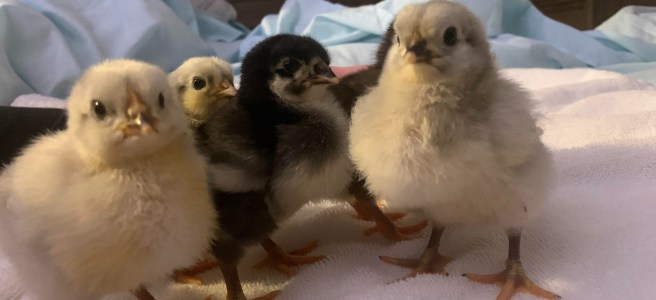
New baby chicks on our farm has become such a common occurrence that I would not normally even think to mention it.
However, our recent batch of chicks is something unique and special.
These baby chicks are the first chicks ever born from our new breeding program!
We’re making purple chickens!
Over the past couple of years since moving out to the farm, we have probably had a couple dozen different chicken breeds – most of which we’ve raised from baby chicks.
It has truly fascinated me to see the vast differences from one breed to the next.
Barred Rocks, for example, are some of the coolest and most annoying birds you can own.
Why?
Well, for starters, they are extremely curious. From their first day out of the shell, they will always be the first in a mixed batch to step forward to investigate new objects, animals, or people. As they grow, that curiosity turns into intelligence.
Thanks to this intelligence, Barred Rocks quickly learn that humans and other animals are generally only going to interact with them in an unpleasant way – whether that’s being picked up and snuggled, moved to a new coop with fresh pine chips, or given a shot of medicine for a respiratory illness.
Obviously, all of these are good things. But if they aren’t what the Barred Rock wants to be doing in that moment, she will not want to do them.
This curiosity and intelligence combine to create impeccable survival instincts. If a Barred Rock and ten other chickens get lost on the way to their coop at night (not uncommon when the days are quickly becoming shorter), the ten other chickens will likely be found huddled together under a random structure – warm, yes, but vulnerable to attack by predators. The Barred Rock, meanwhile, can be found at the highest point possible for a chicken to reach, even if it takes multiple jumps.
This makes Barred Rocks some of the most annoying birds you can own – but also some of the most fun. They are amazing foragers, can have spunky personalities and are usually more than a little sassy… but they hate being picked up and they will randomly decide that they are going to move out of the coop and live in the trees at night now. Or, they’ll decide that the nest box you provided is not up to their standards, so they will make a new nest in a very concealed, secure spot. Great for incubating eggs if you’re a broody hen, but horrible if you’re a hungry human trying to make a burrito.
The problem with breeding barred rocks, besides their at-times challenging personalities, is that the roosters are absolutely useless. Skinny little things with way too much attitude and far too cocky for their own good. They won’t usually be a good alpha male, and they aren’t very efficient meat birds.

Every breed has their quirks.
Buff Orpingtons were an early favorite of mine. My favorite chickens (and one of my best friends) was a Buff Orpington, creatively named Buffy. She was one of our first chickens and grew up riding on my shoulder or hat while I did my farm chores in the morning. She would act like she didn’t want to be picked up but once she was placed on my head or shoulders she would refuse to come down and would stare at the world in wonder as we went on adventures together. I even took her with me to the back pasture a couple times and she would always follow along right behind me like a faithful puppy.
Ameraucanas (a popular homestead breed) are reliable egg layers with good personalities, and fairly resilient, but they are small, don’t have the best survival instincts, and lay small to medium-sized eggs. Red Stars are great mother hens and extremely reliable layers. Whiting True Blues are selfish screeching jerks. Whiting True Greens are gentle and friendly but are frequently killed by their own curiosity. Leghorns are dumbasses. In fact, I still have one, and her name is Dumbass The Second. Dumbass The First died by flying over a 4 foot fence into the dog pen… like a dumbass.
Dang! That was an awful lot of text to you to read for me to not even tell you how we’re making purple chickens! Thanks for sticking with me – I’m extremely ADHD and tend to ramble.
All that to say, we tried out a lot of different breeds before choosing one to replicate.
It all started with Buffy the Buff Orpington that I mentioned above. We had a few other Orpingtons and between them and her I developed an appreciation early on for these friendly, quiet, reliable birds with big fluffy butts.
My concern with Buffy and the other Orpingtons was primarily their size. They just aren’t very big birds. And, while Buffy was friendly enough, I was hands-on with her since she was a few days old. My other Orpingtons weren’t like her – they don’t like to be picked up or petted, which is one of my favorite things to do here on the farm. In the winter, chickens make great hand warmers! And if you find a lost or sick chicken or if you are trying to deal with a sassy chicken who won’t let you move her, try this trick… stick her in your jacket! They love that. Especially Orpingtons. My birds love to snuggle into a nice winter coat that’s all zipped up, and they rarely want to come out.
Stop it, Trey! You’re being ADHD again!
…Sorry.
Anyway. I started to check out different Orpington breeds. I got my hands on three baby chicks from an acquaintance that breeds Orpingtons, but all of his go into the same brooder so he wasn’t sure what I’d end up with. I ended up with one MASSIVE Black English Orpington rooster, one extremely large Chocolate Orpington rooster, and one Jubilee Orpington hen.
These chickens were something else! Lemme tell ya… nothing made me happier than seeing those giant fluffy butts bouncing around the yard. But, unfortunately, I didn’t end up with a breeding pair of any of the three breeds, even though they were all supposed to be Chocolate Orpingtons.
I ended up getting a line on some Orpingtons one day, and went out to pick them up. First up were two Chocolate hens and a rooster. Much smaller than mine, but I figured they weren’t done growing. Next, I had a couple Orpingtons with really funky colors – I don’t remember the name of the type. They ended up being sick and didn’t make the transition.
But… at the last minute, the guy I was buying them from managed to get his hands on a perfect breeding pair of rare Lavender Orpingtons! The hen, who I named Henrietta, was sweet as pumpkin pie. Medium sized and happy as a clam to sit snuggled in a nest box all day. The rooster, who I named Ender, was another story altogether. He easily dwarfed even my Hulk of a Black English Orpington rooster, and was probably closer in size to my (at the time) teenage male turkeys than he was to any of my chickens. His plumage looked like he had been drawn by a master painter, and he was assertive and strong but also docile and absolutely indifferent to being picked up and snuggled. I’ve never seen as perfect of a specimen as Ender, and I probably never will again.
Unfortunately, Ender died. (audience gasps)

In my rush to snag the Orpingtons when the opportunity presented itself, I didn’t have time to make a secure breeding coop for these new birds. Less than a couple weeks after I bought them, a fox ran out of the woods in broad daylight and tried to nab Jubee, my Jubilee Orpington hen. Ender attacked the fox and successfully got him off of Jubee – but got dragged off into the woods himself for his trouble. I tracked him through the woods and found feather evidence where he had clearly escaped six separate times, but as best as I could tell from the evidence, the sixth time he escaped he actually ran into the fox’s den thinking it would be a safe cover.
So, back to square one. Or, square one and a half, since I at least had Henrietta.
A couple months later, I found someone about an hour and a half away who had four Lavender Orpington roosters she was selling very cheap because she had raised them to be meat birds but couldn’t bring herself to butcher them because they had such sweet personalities.
Well, she was right about the sweet personalities. These four roosters were inseparable. They never fought each other, stayed glued to each others’ side at all times, and shared all of their resources. They also didn’t eat any feed I put out for them, preferring to wander deep into the woods to forage. No complaints!
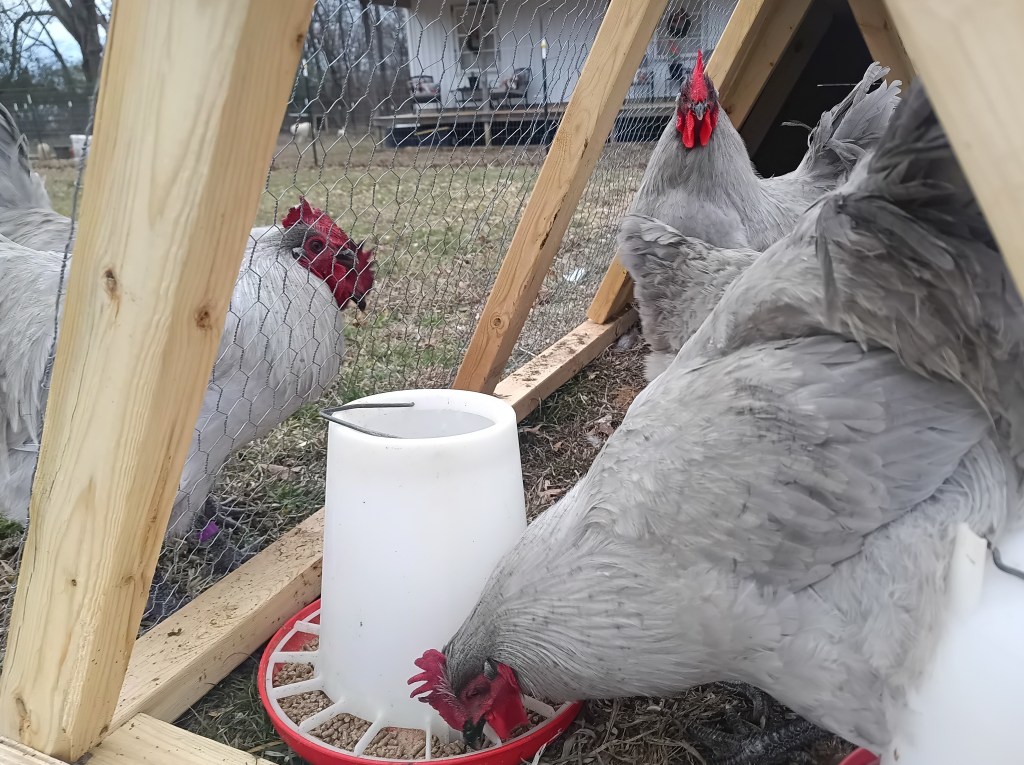
While none of these four roosters held a candle to Ender’s genetic superiority, they were all excellent examples of the species. Given my luck so far, I was happy to get four of them in case anything happened. It is very common to lose birds during a transition period due to new diseases they’d never been exposed to, stress, and other factors.
Sure enough, one died a few weeks later – never did find out why. As docile as they were, they were getting picked on by my more dominant roosters who resented four new large and impressive-looking roos suddenly moving in. Things tend to get tense when you have more than one rooster per ten hens. I think he may have just taken a really bad peck in the wrong spot.
One of them got sick and died – again, not uncommon when moving adult birds to a new environment full of germs and bacteria that their immune system has never encountered.
A third one, the alpha of the foursome, recently got his head stuck in a hay bale. Not the brightest bulb in the economy pack. His brother snuggled up to him to keep him warm and to draw attention to his predicament, and I was able to save him – but not before he’d spent an entire day stuck between two hay bales in freezing temperatures. He’s still alive, but he got frostbite on his comb and appears to have been oxygen deprived long enough that he may have brain damage. He may or may not make it. The fourth one is still perfectly fine.
While all this was going on, however, I had Henrietta on a rotation in her new breeding coop – swapping out a new rooster every week. She was probably the happiest animal on our farm and laid me a new fertilized egg every single day even in the deep winter. I add eggs to the incubator once a week to avoid too many temperature and humidity fluctuations, so the first batch had 7 eggs.
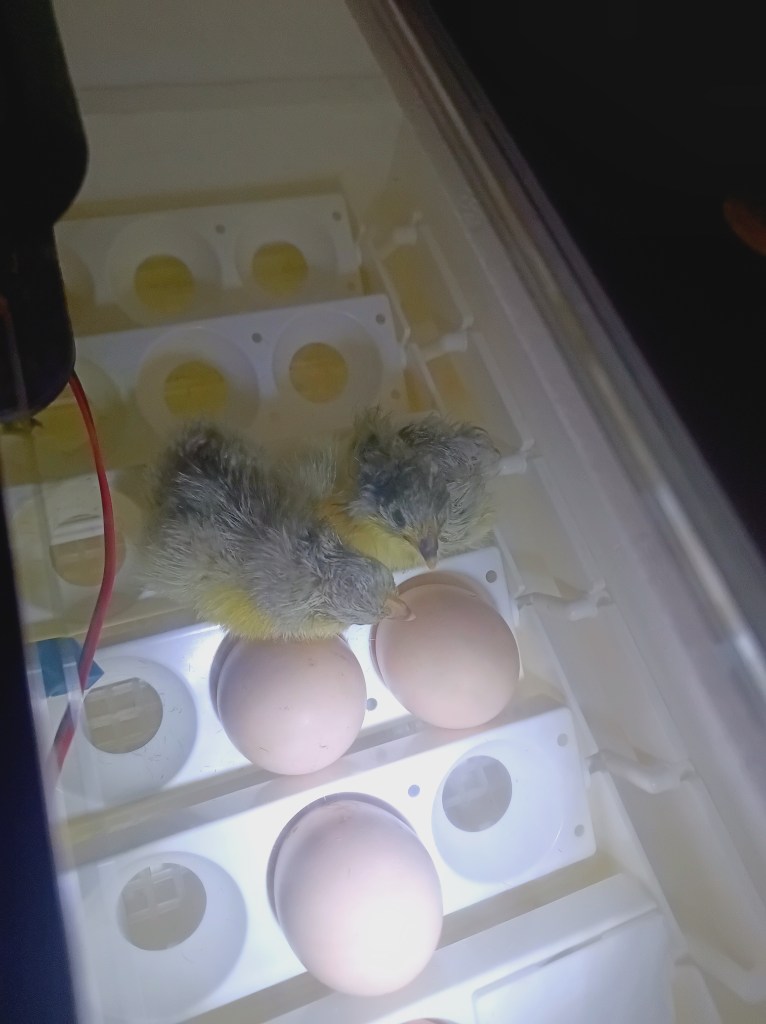
Sure enough, three weeks later, the first eggs started cracking open in the incubator! We appear to have ended up with one Chocolate/Lavender cross. In case you don’t know, rooster sperm can remain in the hen ovum for a couple days before fertilizing an egg, so that was from before she went into the breeding coop.
The next four eggs came out perfectly – three grey babies and one black one! Overall, we had five chicks out of seven eggs, which was impressive considering that I accidentally left the water plug out on the table and their humidity was in the 20s and 30s for the first half of their development.
It’s always funny when I tell people about my “Purple Chickens” because at this point I usually pull out my phone and show them some photos.
“But wait… THOSE AREN’T PURPLE!”
Okay… technically… they aren’t purple.
But they are called Lavender Orpingtons, so I will continue to refer to them as my Purple Chickens, or Purple Bois. Why? It’s fun! And life isn’t worth living if you aren’t having fun every now and then.
In order to breed Lavender Orpingtons, you actually need at least one Black Orpington rooster. You have to mix that black gene back into the gene pool every 3 or 4 generations or their color gets really washed out and their feathers have quality issues. That’s why I said that 3 greys and 1 black chick were perfect. It may grow up a Lavender after all, or it may grow up Black. Either way, it’s perfect.
Lavender Orpingtons are, quite simply, the best.
Why? Here’s ten reasons why these rare Lavender Orpingtons are the best chicken breed ever:
- They are massive. Just freakishly massive.
- Roosters are extremely non-agressive, but also assertive in their flock and highly protective of their hens.
- Hens are reliable layers of medium-to-large pink eggs.
- Both genders are very docile.
- Both genders are excellent foragers for free ranging but also perfectly happy to live in a coop. In fact, my Lavender Orpingtons confined to a coop honestly seem much happier than my free ranging birds.
- Due to their size, they are a fantastic dual-purpose breed – meaning they work equally well for eggs or for meat.
- Also due to their size and extremely fluffy butts, they are unable to fly over fences. I have a lot of animals in various pens and have lost quite a few chickens to “suicide missions” when they fly over the fence to the dog pen for no apparent reason (it is NOT near their coop). My main coop is also a movable coop with Premiere One electric netting around it and many breeds (*cough cough* Red Stars *cough cough* Barred Rocks *cough* Leghorns *cough*) fly right over that. While I normally prefer to free-range my birds, it is very important to be able to keep them inside the netting when I’ve recently spotted foxes or coyotes in the area.
- They don’t mind being picked up. Like all birds, they will often avoid being picked up because they don’t want to be seen as less dominant in front of their other bird friends, but they do not mind being held or petted at all once picked up.
- They are as sweet as pumpkin pie. I may be a little biased, but their precocious personalities seem above and beyond all of the other chicken breeds we have here on our little homestead. They are loyal to a fault, eager to share their resources with their friends, and would rather snuggle each other than fight.
- They are absolutely gorgeous. Their coloring is so unique – light grey with a light purple tinge. While not “purple” per se, the term “Lavender” certainly fits them to a T.
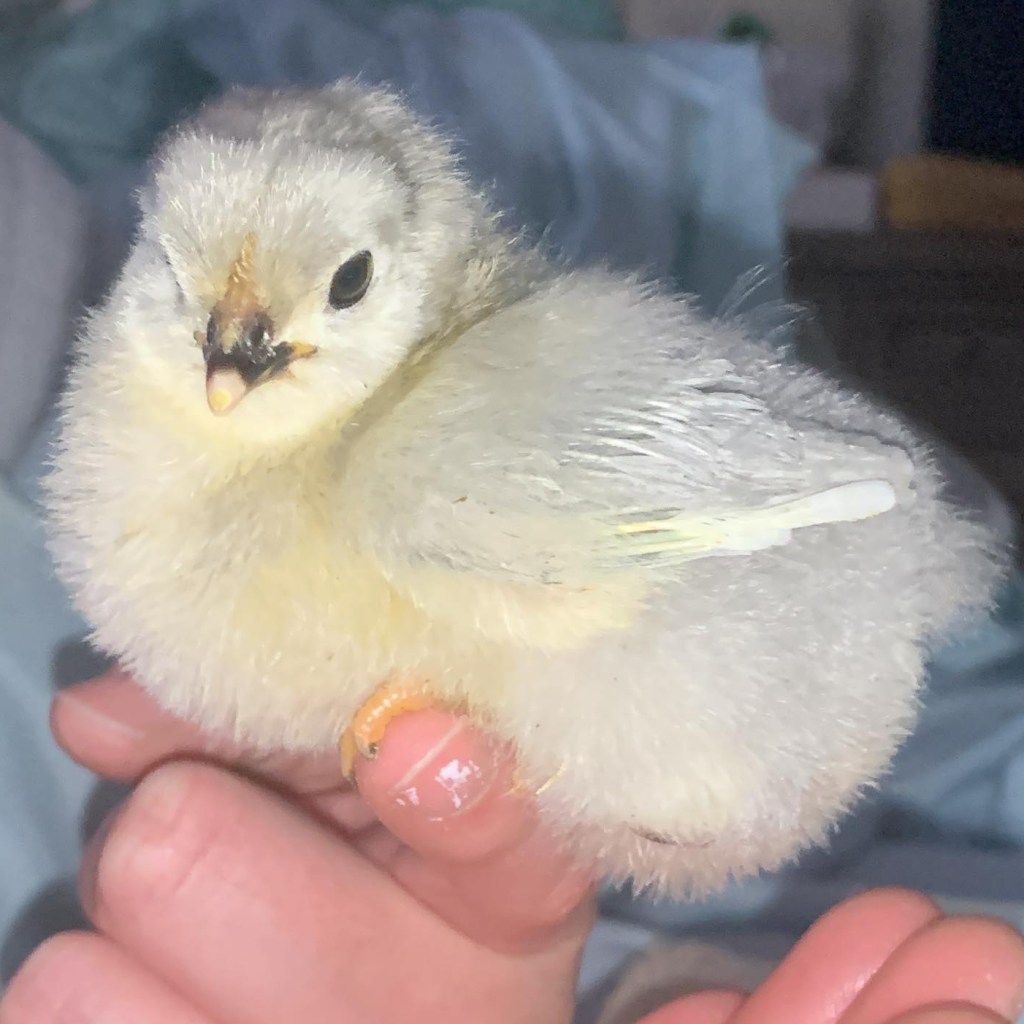
We’ve kept this first batch so that we can grow them out and start “making” more than one bird per day in a few months. But new chicks are available for purchase.
In the dead of winter right now I can only guarantee 1 or 2 per week but Henrietta sometimes lays 7 eggs a week even in freezing temps. So far, 100% of her eggs have been fertilized. Once things warm up at all, I can confidently guarantee 3-4 per week.
1-to-2-week-old unsexed chicks will be available for $10 each or 5 for $40.
(a minimum order of 3 is required if you do not already have chickens, since chickens will die if they are alone)
Orders can be placed up to 3 weeks in advance, and can be ordered anytime by e-mailing middleforkfarmsal@gmail.com or texting 256.856-9285. Right now we can only do local orders (we are in Franklin County, Alabama), but I do hope to ship eventually.
As a reminder, we do also have chicken eggs ($3/doz) and duck eggs ($5/doz) available for local purchase as well. Most of them will be fertilized if you want to hatch them but they’ll be mixed breeds from our free-range flock. All of our birds eat very well and their eggs are very delicious and nutritious.
I have just finished building a second breeding coop, which I have placed my Chocolate Orpingtons in. Once I get some successful hatches from them, they will be available at $7.50/each or 5 for $30.
I am also planning on breeding my Cayuga ducks, Welsh Harlequin ducks, and Blue/Chocolate Kahki Campbell ducks as soon as I can get their respective coops built (no prices yet).
 Middle Fork Farms