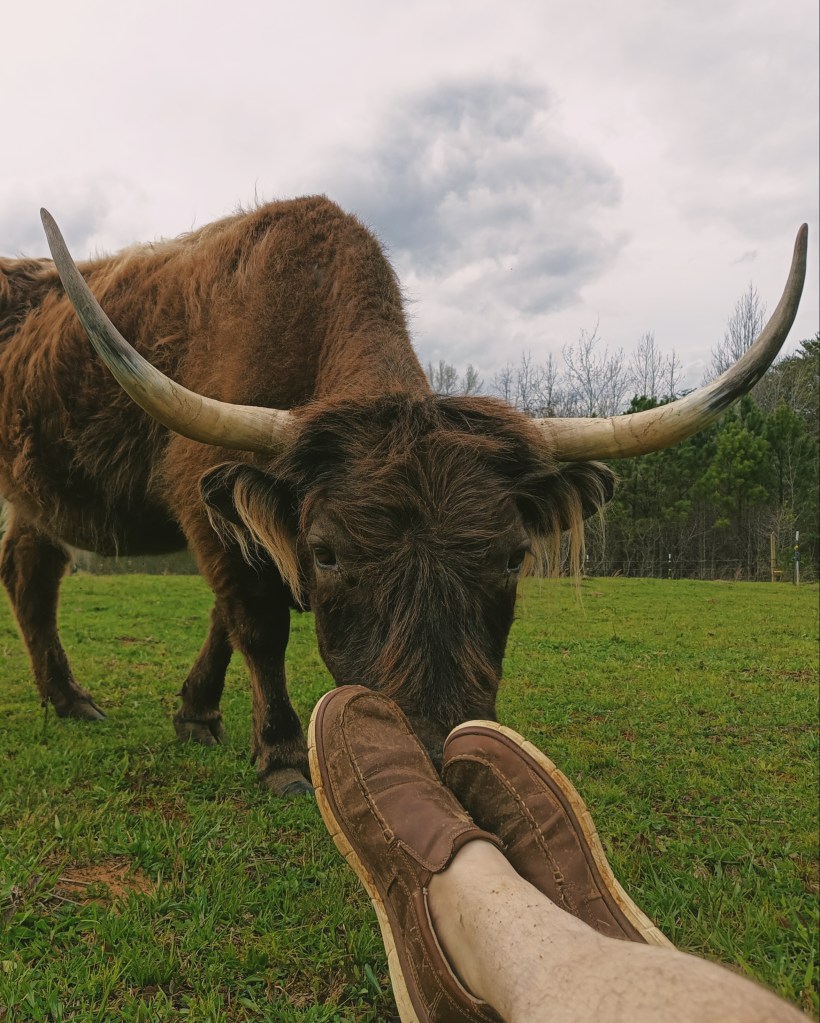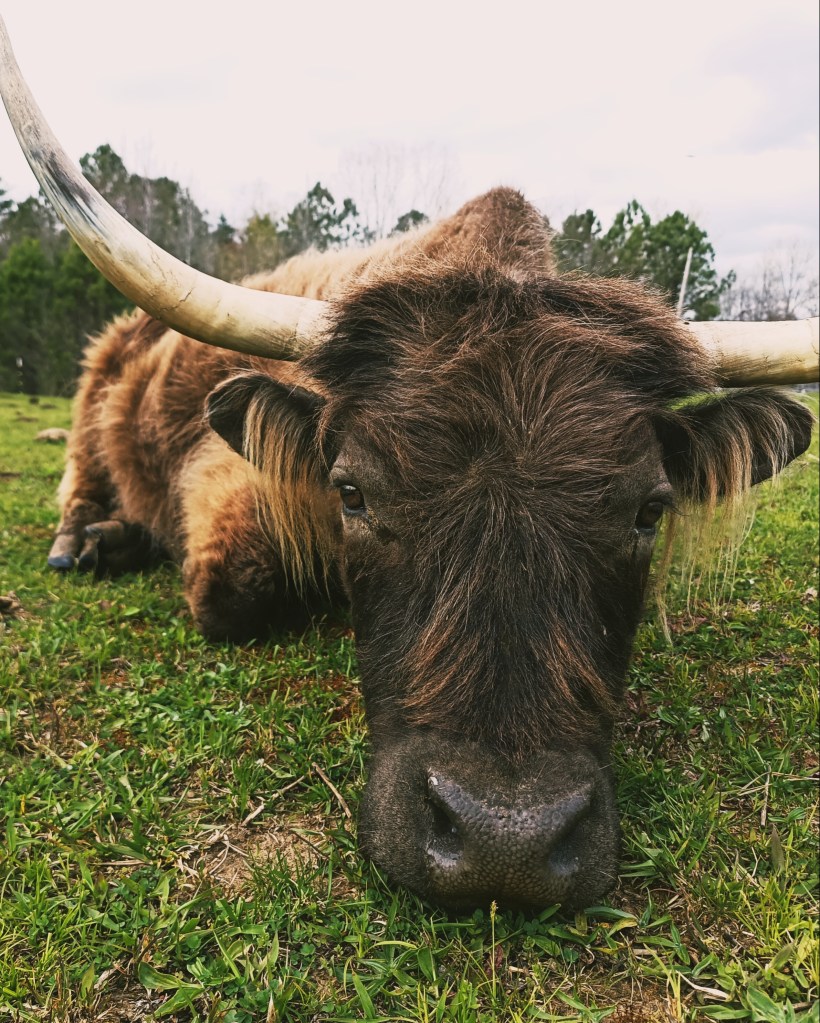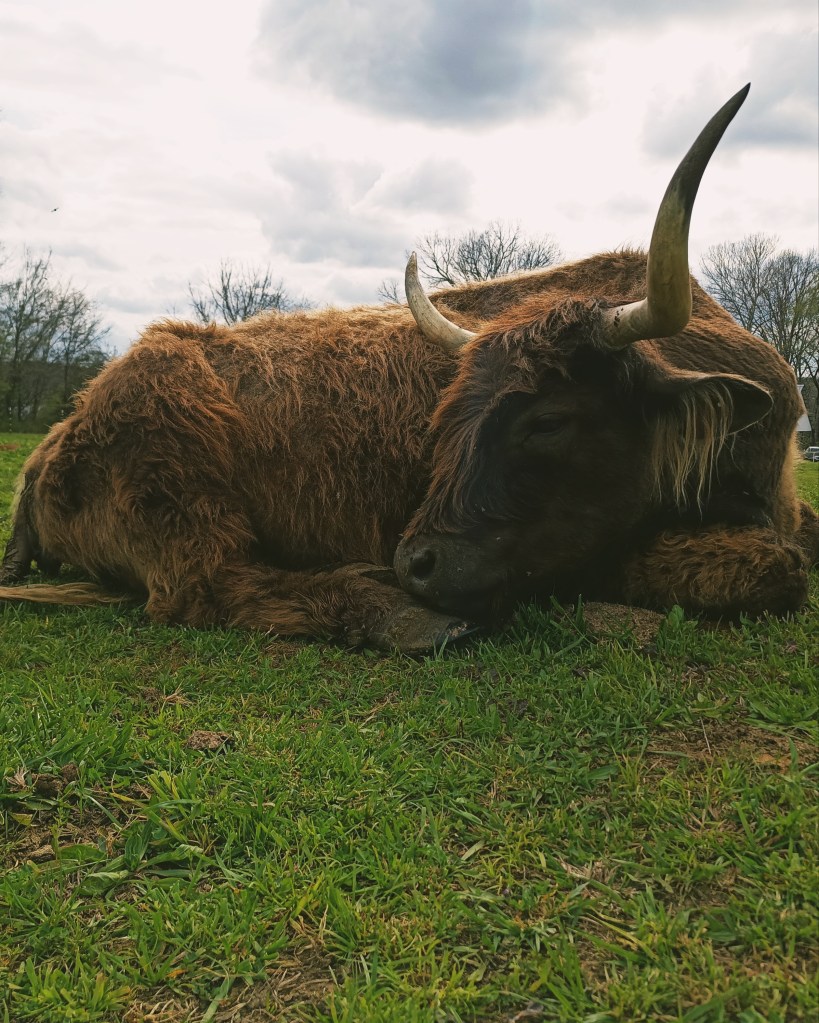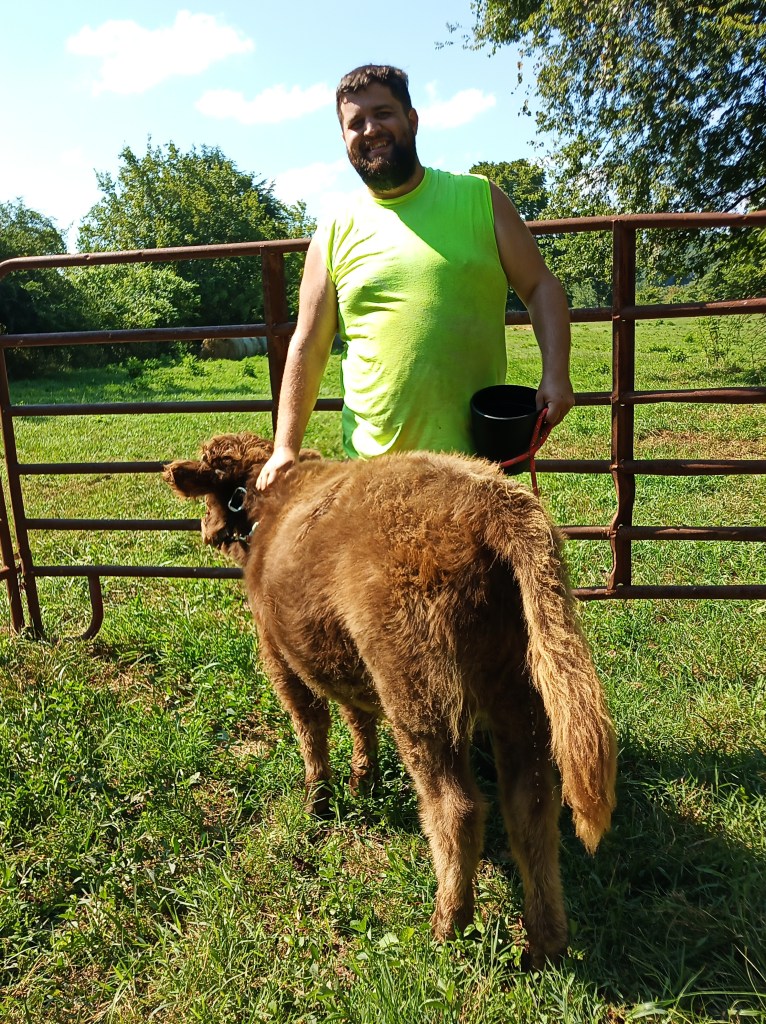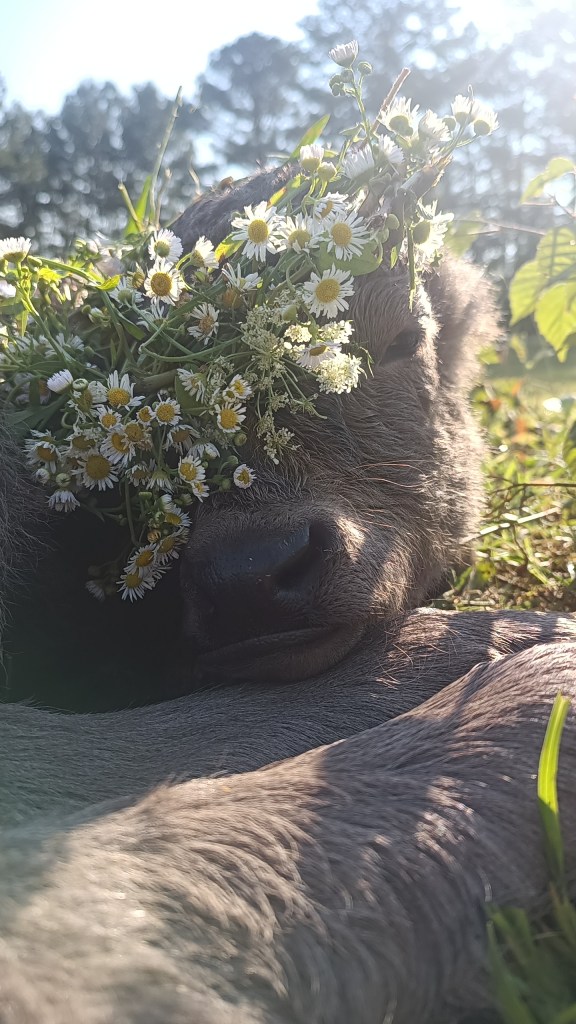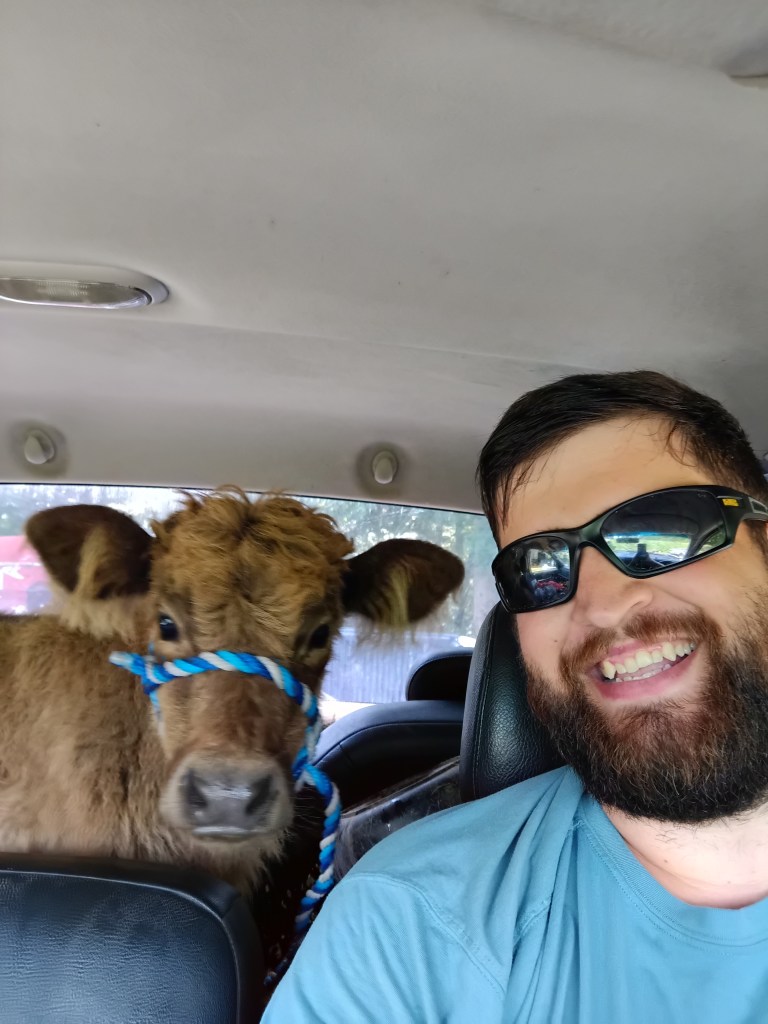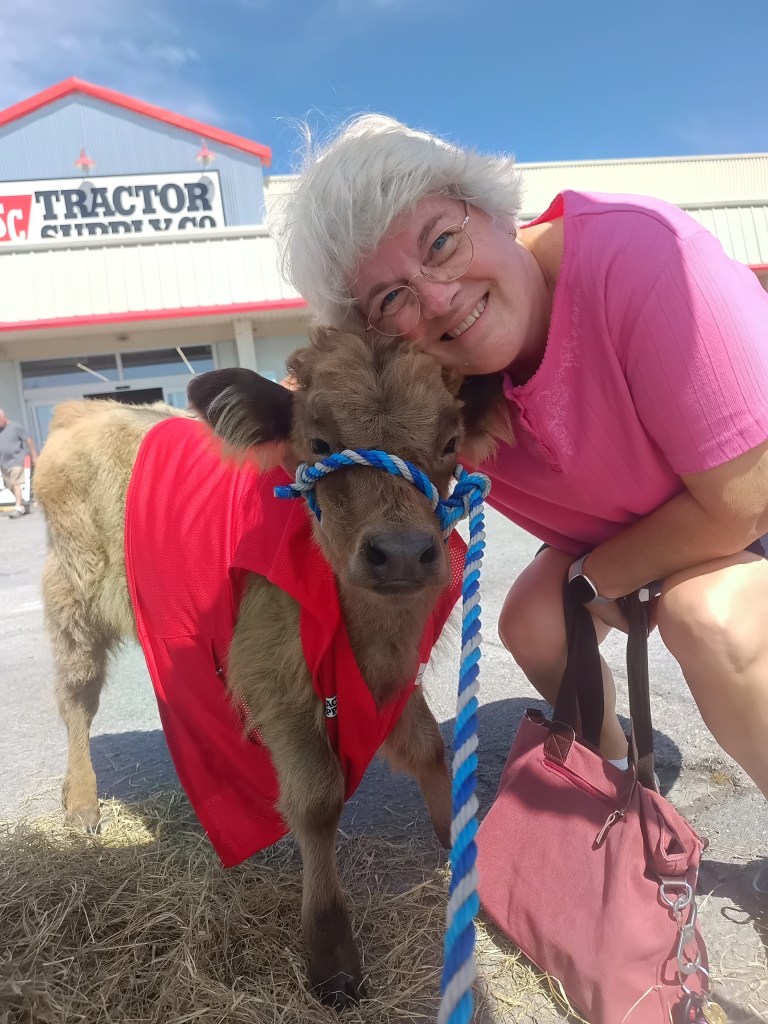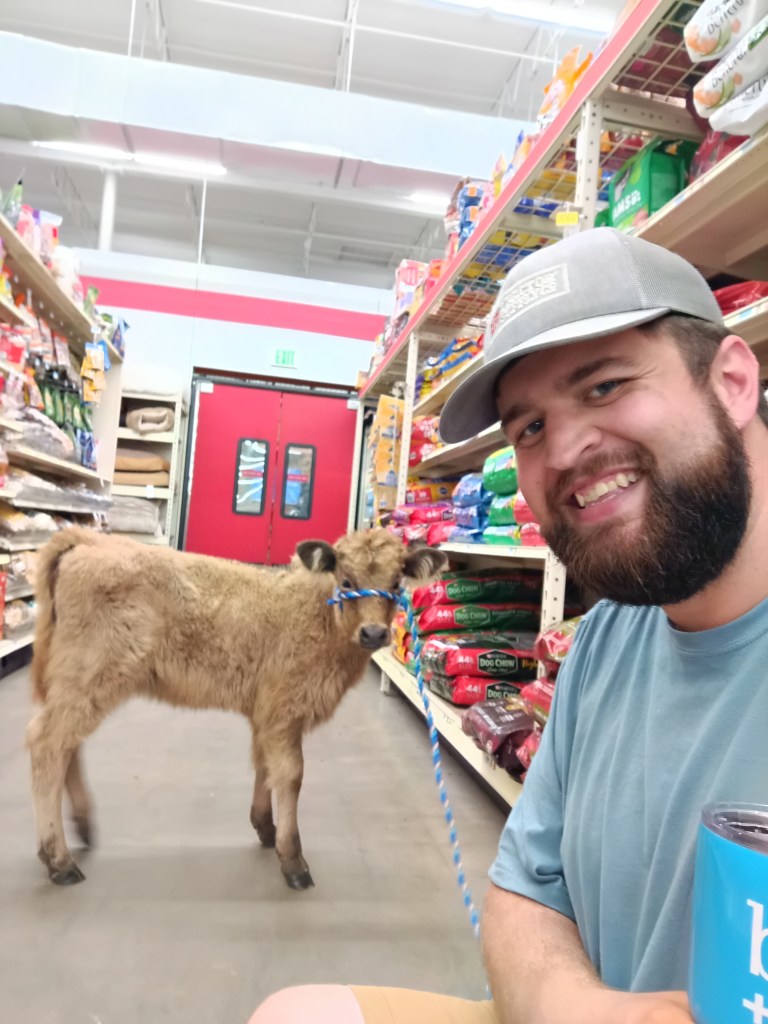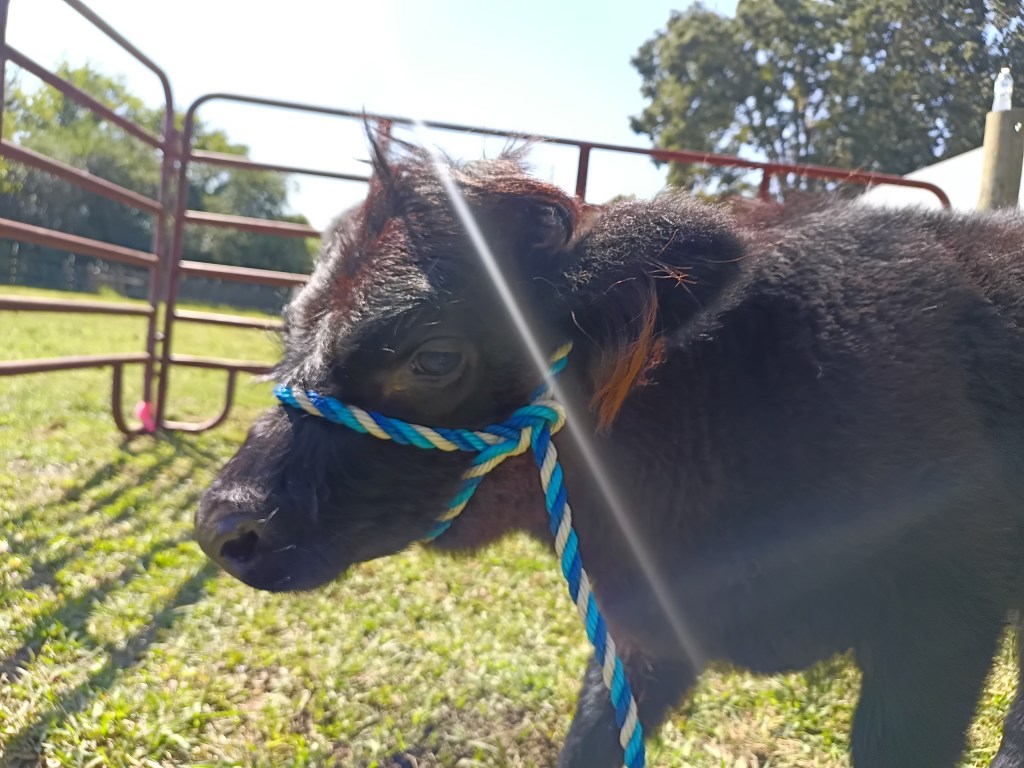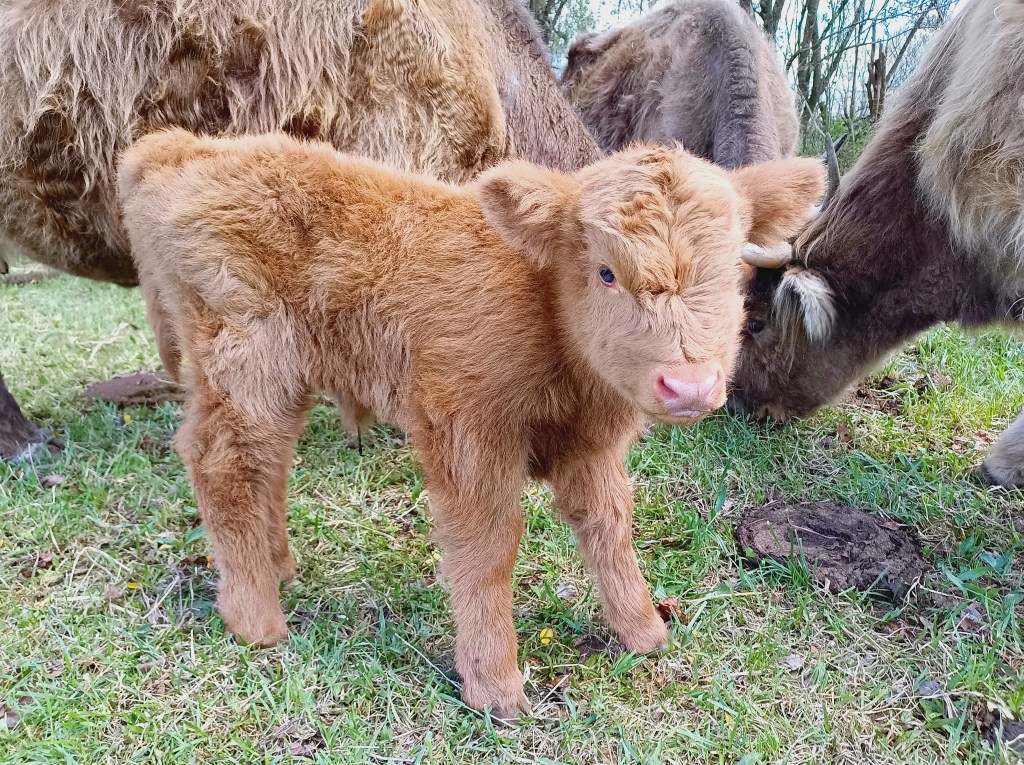
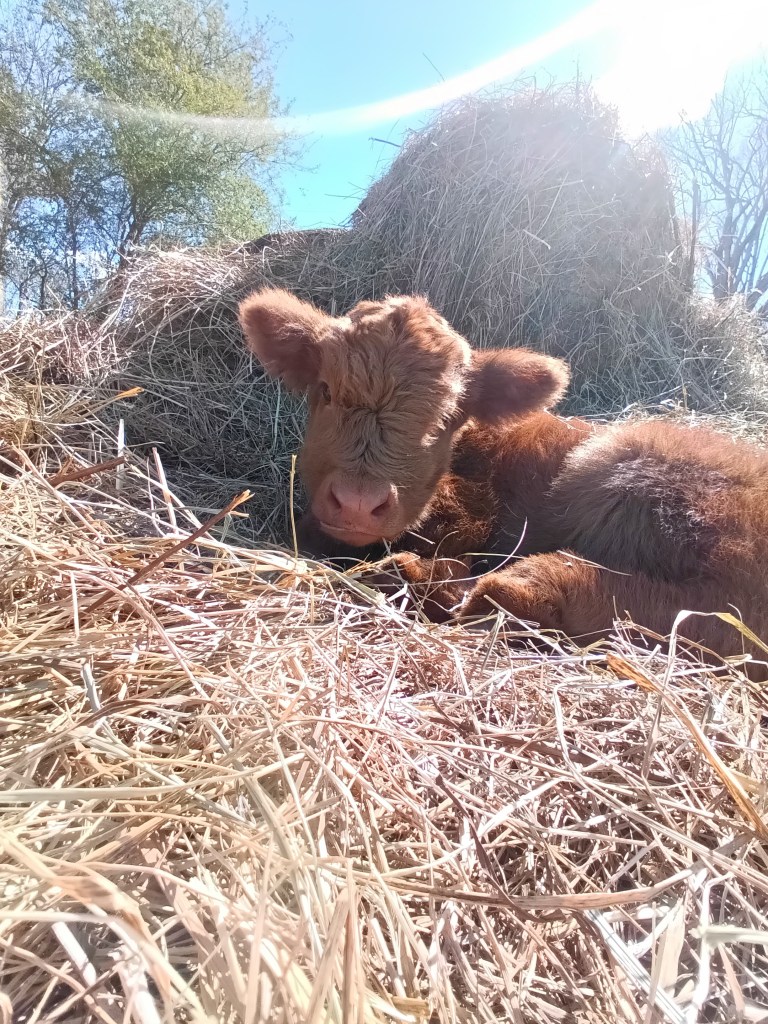
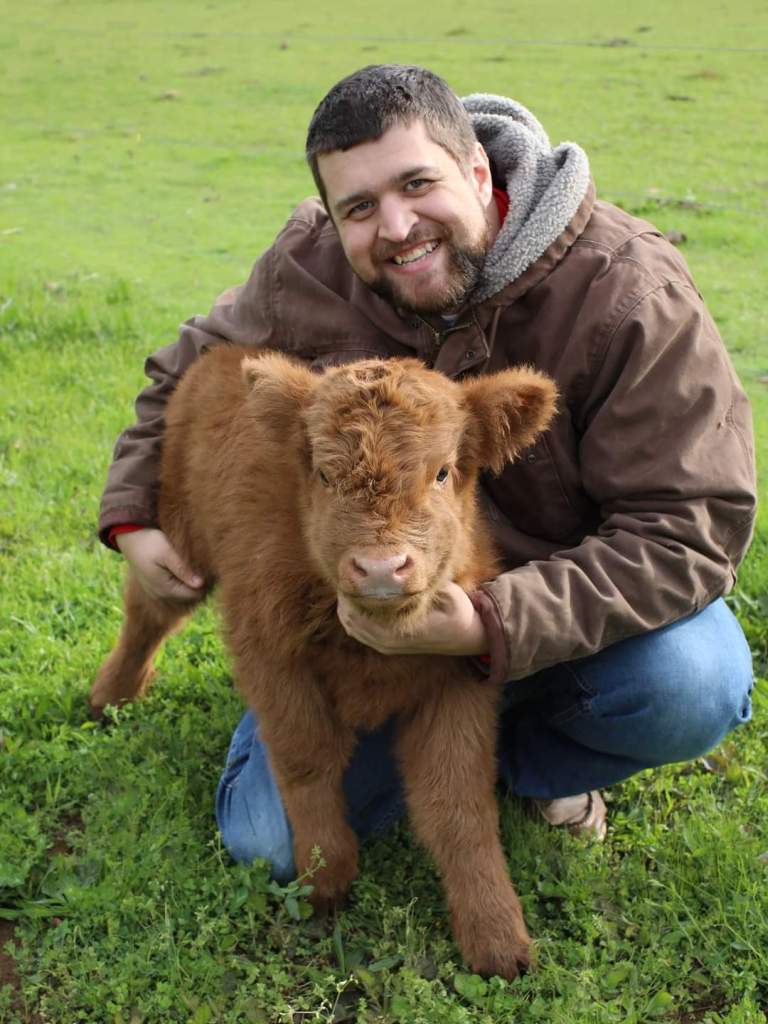
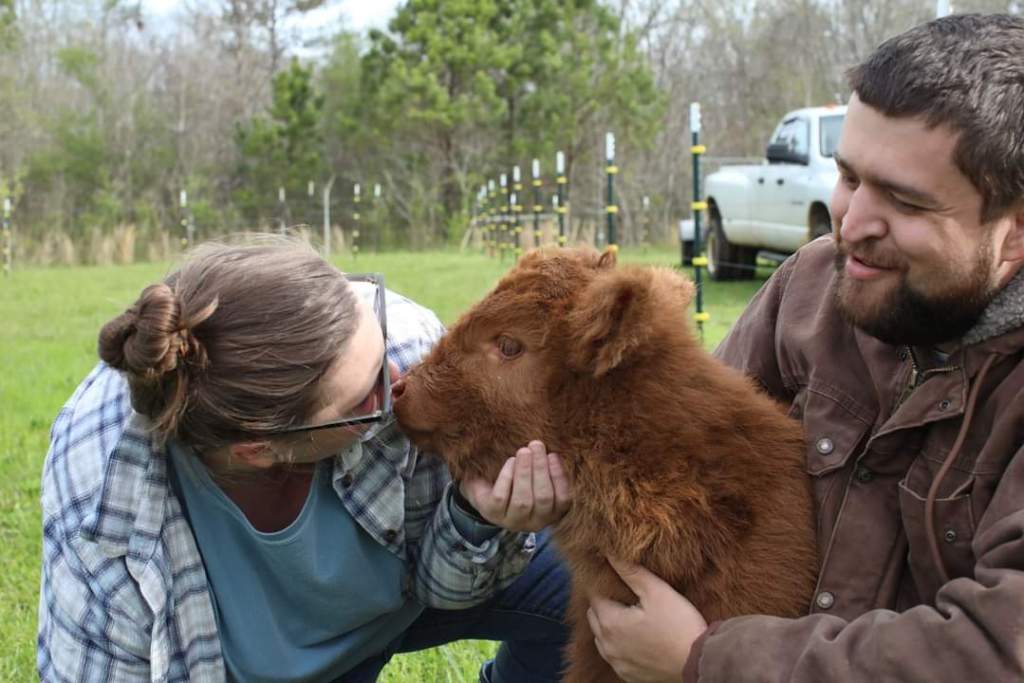
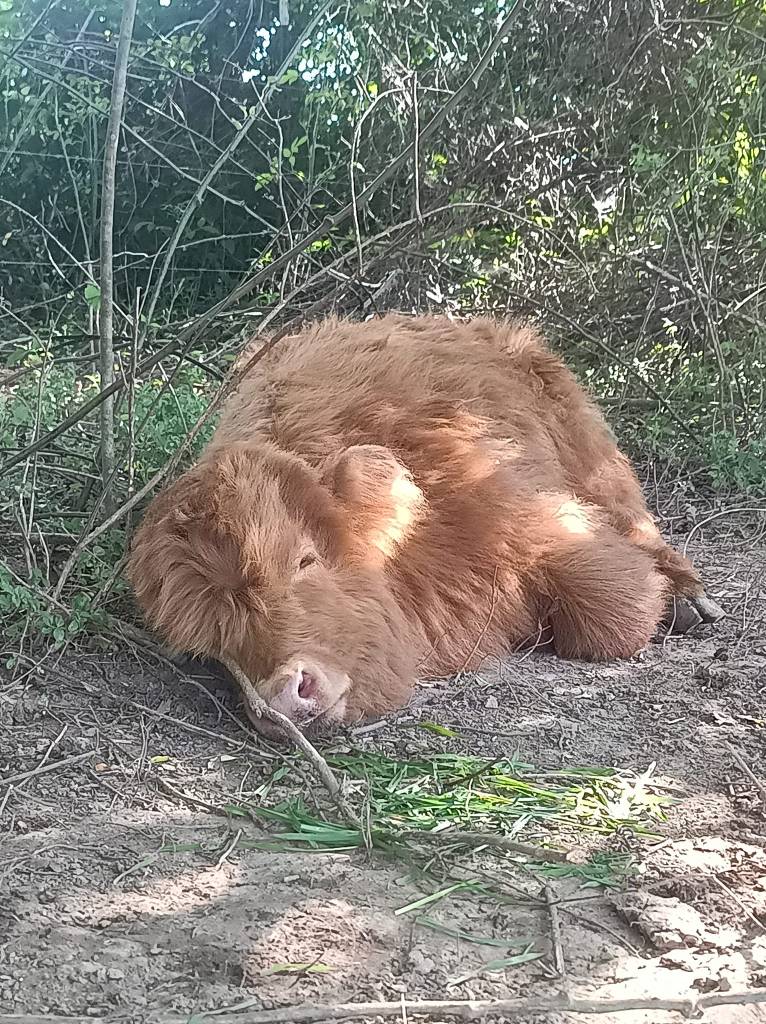
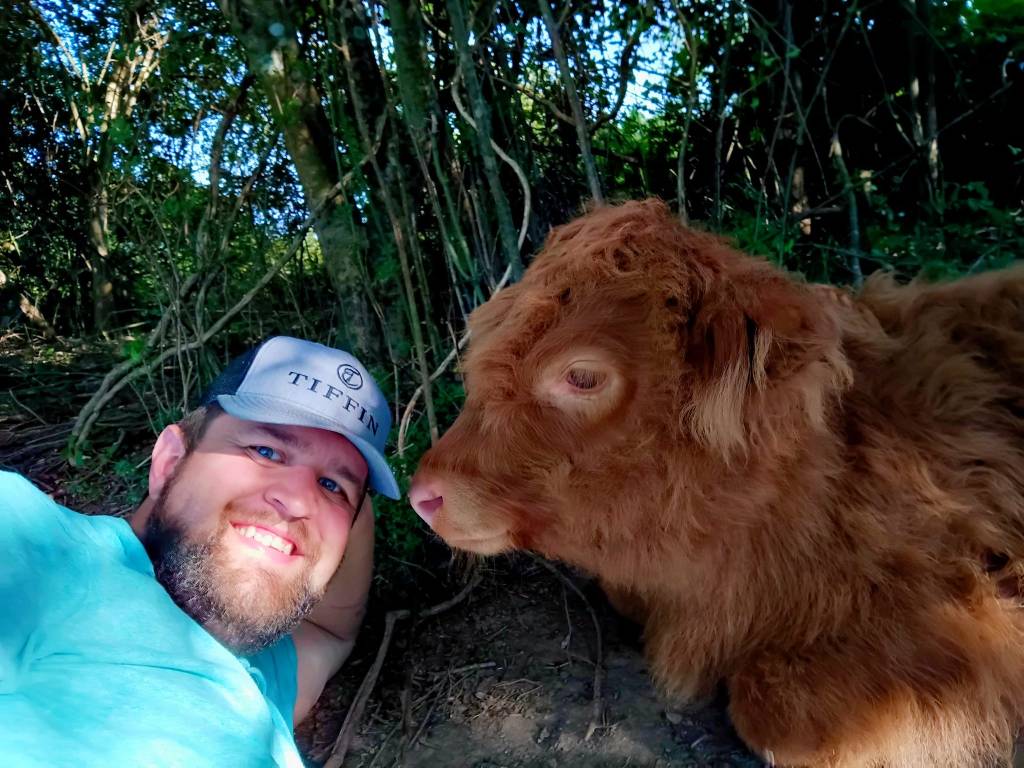
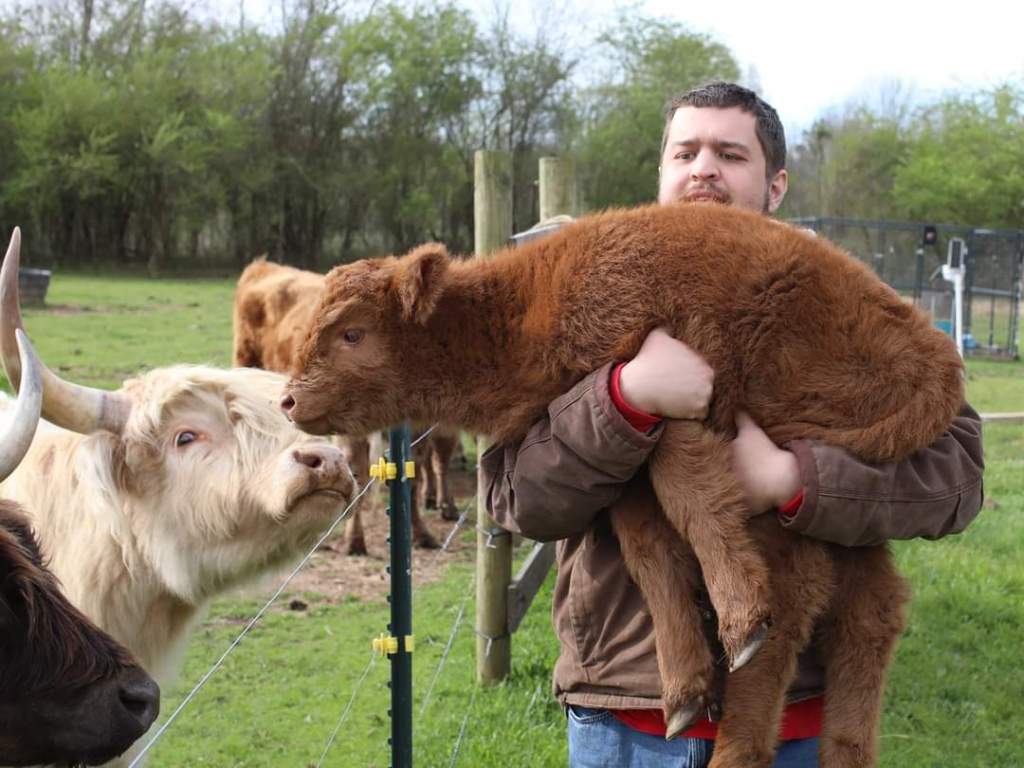
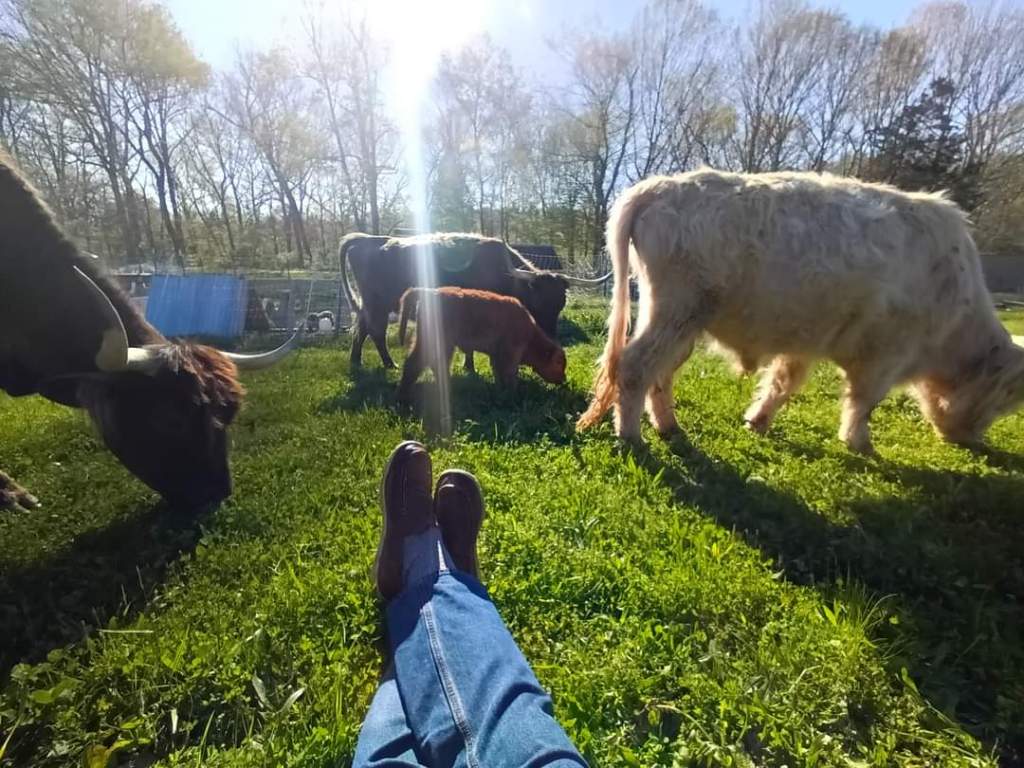
“April” – Red Highland Heifer Calf (AHCA)

STATUS: SOLD


Name: April
Birthdate: 4/1/2024
Color: Red
Gender: Heifer (Female)
Breed: Purebred Scottish Highland
Registration: American Highland Cattle Association (will be registered upon weaning)
Sire (Father): Fergus (aka “Adcock McCool 99 (D)”) (Click for AHCA Registration)
Dam (Mother): RBA Morgana (Click for AHCA Registration)
Favorite Treat: Wonder Classic White Bread
Favorite Scratch Spot: Shoulder at the base of her neck or under her chin on the side of her jawbone.
Price: $6,000 (50% Deposit, 50% On Pickup) – Transport Negotiable
Location: Russellville, Alabama
Available For Pickup: September 1st 2024 (SOLD)


Scottish Highland Fact: Purebred Scottish Highland cows are a “heritage” breed, which means that they have been bred over centuries for health, temperament, and intelligence. As a result, they are more docile and easier to manage than a breed like Angus, which has been bred for rapid weight gain and is known for poor health and temperament.


April is a very sweet and highly intelligent girl with outstanding breeding credentials.

Like her parents April is skeptical and slow to trust, but once you gain her trust she will trust you completely. She is docile and relaxed and loves playing with other animals her size. She has been completely mama-fed and mama-raised since birth and started eating grass less than two weeks after she was born. At the time of this post she is less than 4 months old and has already entirely herself weaned off of her mama’s milk.

Her diet has consisted entirely of fresh grass and high-quality minerals, with the exception of the occasional treat. She has tried numerous brands and types of bread and has recently decided that the only one she will eat is Wonder Classic White Bread slices. It absolutely must be Wonder Classic brand or she will spit it out on the ground and pierce your soul with a sharp look of betrayal.

Based on her body frame and hair type, I expect her to grow up looking almost identical to her sire, Fergus.


Scottish Highland Fact: Scottish Highland cows are extremely docile and friendly. As long as they trust you, feel safe, and have adequate food, shade, and water, they won’t try to break out of your fence or leave your property like commercial beef cattle breeds.


Parents
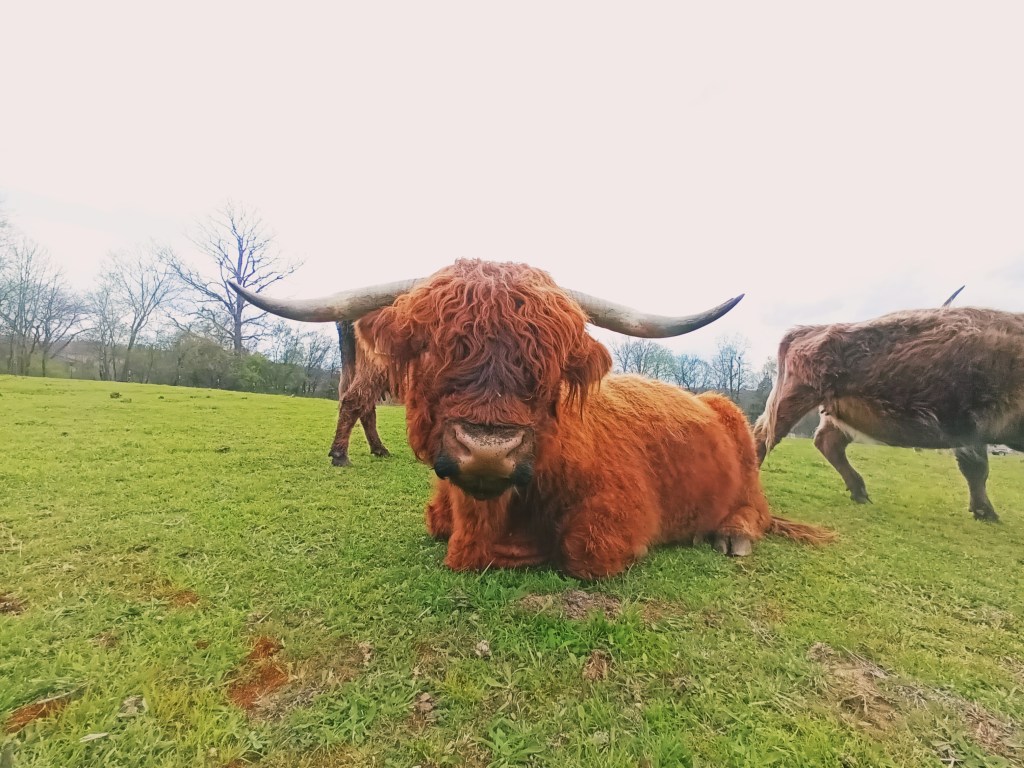
April’s sire (father) Fergus is an 8-year-old large red bull with championship bloodlines and a classic old-school Highland frame. Fergus is the herd sire here at Middle Fork Farms, meaning he has seniority among the bulls. He is extremely mature and restrained – he will never start a fight. If challenged, he easily puts other animals in their place without harming them.

April’s dam (mother) Morgana is a 6-year-old mid-sized dun cow with a traditional frame. She has very predictable pregnancies and easily births babies of relatively large birth weight. She is an excellent mother and will protect, hide, and provide for her babies better than any other animal on my farm. Like Fergus, she is an extremely mature and calm animal. Morgana is very skeptical and slow to trust but once she decides to trust you she is extremely loyal.

Morgana has allowed me to interact with April from the moment she was born, even while she was being milked by her. She welcomed my presence at April’s birth and even encouraged me to help her clean April up afterwards. In fact, you can watch a recording of April’s entire birth here (click to open in a new tab).


Scottish Highland Fact: Despite popular use of the term, there is no such thing as a “Miniature Highland Cow.” Scottish Highland cattle are simply shorter than most beef breeds because they have been bred for health and hardiness rather than size. Most “Miniature Highlands” advertised for high prices online are mixed with a Dexter in order to give them a genetic disorder called Chondrodysplasia (medical dwarfism). Despite fetching sky-high prices online from uneducated buyers and being very popular as calves for cute photoshoots, these cows will suffer from a variety of health issues as soon as they hit adulthood and will live a fraction as long as a healthy cow.

Intentionally breeding genetic traits that negatively affect an anima’s health is unethical and will never be done on our farm.


Training
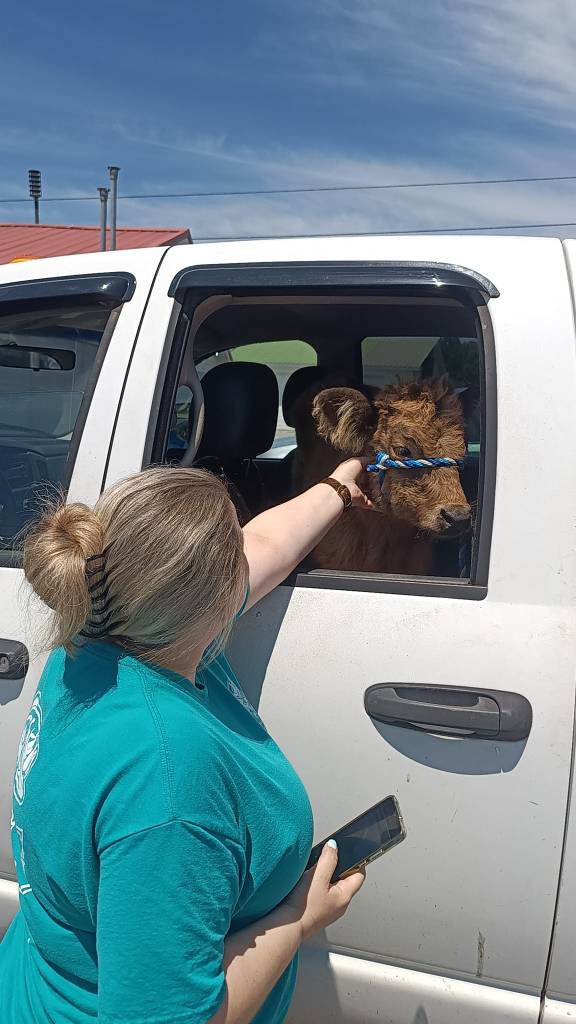
We sell fully-trained Highland calves that are perfect for homesteads and farms of all sizes!

Our training program ensures that our calves are safe around kids and other animals, and it also makes them much easier to own and manage. My entire herd is trained to a single strand of yellow rope. I often open the main gate so they can come into my front yard and mow my grass, then go back inside their pasture.


Scottish Highland Fact: Scottish Highland cows love to eat brush, trees, and many grasses and weeds that other cattle breeds will not eat. They are commonly used as working animals on homesteads and are used for clearing brush and keeping trees trimmed.


To complete their training, all calves MUST meet the following criteria:

  1. Will allow themselves to be haltered.
  2. Will follow you on a lead without needing to be pulled.
  3. Does not show any aggression at all to humans or other animals, especially during training.
  4. Will approach you and let you interact with them when you have a treat.
  5. Will not attempt to cross a single yellow strand of polywire.

We will not sell a calf as a pet or breeding stock that does not meet all of the above criteria.


Scottish Highland Fact: Scottish Highland Cows have an average lifespan of 15-22 years and will birth an average of 12 calves during their lifetime – compared to an average natural lifespan of only 10-12 years and 5 calves for beef breeds like Black Angus. This is one of the main reasons registered Highlands are so expensive – it’s all about the return on your investment!


Most of our calves have been successfully trained to an even higher standard. Based on April’s temperament and how her training has gone so far, I expect her to meet our higher standards as well:

  1. Does not resist being haltered at all
  2. Will not attempt to remove a halter if left on for an entire day
  3. Will approach you and let you interact with them based solely on a desire for affection, NOT a treat.
  4. Will walk the entire perimeter of my 3-acre training pasture on a lead that I am holding onto with only two fingers.
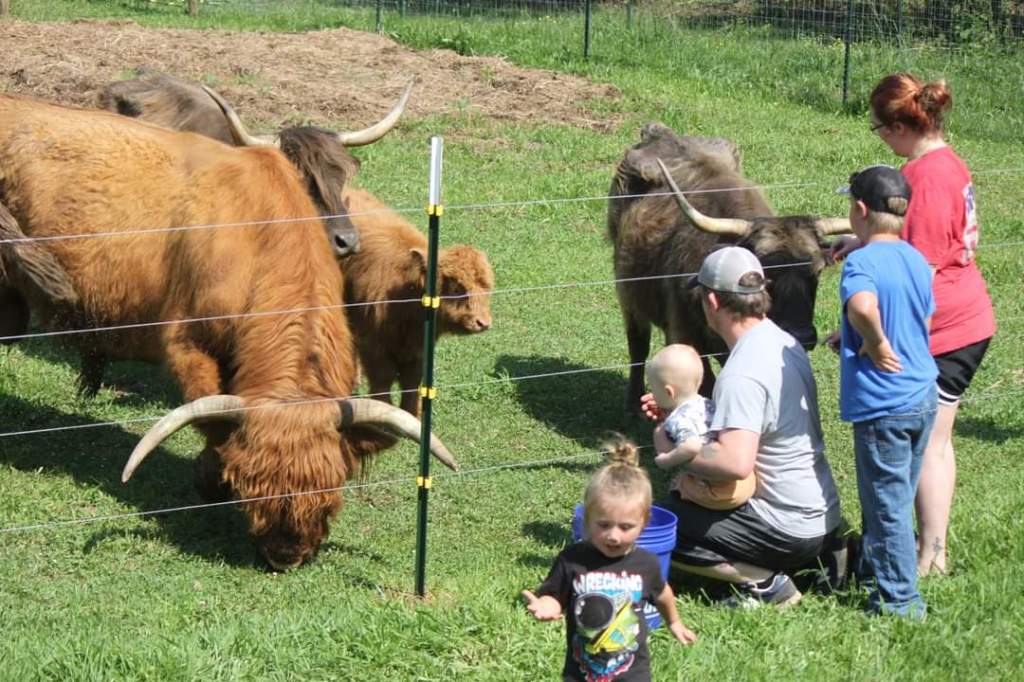
  5. Has safely completed at least two 2+hour events where they interacted with the general public and small children.

Most training takes place in the same open pasture that both parents live in, with them having full access to me and the baby at all times. This allows for trust to be built very early on, as the calf sees their parents be completely okay with me handling them. I have handled three of Morgana’s babies now and she trusts me completely, which really helped me build trust with April.

My philosophy is that if mama doesn’t think I should be doing something, I shouldn’t be doing it. Highland cows are extremely intelligent and have a well-deserved reputation for being excellent mothers – protective and nurturing but also relying heavily on their larger family to help raise the calves – including any humans they consider part of the herd. It’s very common for my mamas to bring me their calves to babysit while I’m out working in the pasture so they can take a break and go eat some grass without being constantly pestered.


Scottish Highland Fact: The American Highland Cattle Association (AHCA) is the premiere organization for purebred Highland cattle. They have the strictest registration standards possible. To register a Highland cow with the AHCA, both parents must already be registered with the AHCA. Additionally, all bulls are required to be DNA tested by an AHCA-approved laboratory in order to verify their lineage before they will be accepted to the registry.

Interested in learning more about Scottish Highland cattle? Check out this article!


Purchasing Information


Scottish Highland Fact: Scams are very common in the Scottish Highland market, especially online. The most common scam is to market an animal online using stolen photos, take your deposit, and then stop responding to you. Never buy an animal without meeting them in person before paying a deposit. If you can’t visit them in person, you can ask the seller for a customized video of the animal that includes the seller’s face saying your name and the name of the animal and the date the video is taken. All reputable breeders are happy to do this for you and anyone who refuses should be considered a scammer.


If you are interested in previewing or purchasing April, please reach out to us at middleforkfarmsal@gmail.com or text/call us at 256-856-928.

You are welcome and encouraged to visit our farm and meet our animals anytime! Use the contact information above to schedule a visit. If you are unable to visit, I can record and send customized videos of any animal you are interested in.

All calves sold by us were born right here on our farm to our AHCA-registered cows.

Animals listed for sale are ONLY delisted AFTER a 50% deposit is IN-HAND. Animals with a deposit paid must be picked up within two weeks of the deposit being received OR within two weeks of weaning, whichever is later.

Local transport (in-state & within 120 miles) is free and non-local transport options are available for additional cost.

Calves are not vaccinated, but we are happy to vaccinate or have any tests done that you’d like, at your cost, at any point before they are picked up.

We screen buyers and will not sell to just anyone. Before selling you an animal, we will ask questions to make sure that you will be taking them to a healthy environment that provides sufficient safety, shelter, food, water, and companionship. We reserve the right to refuse to sell any animal to any person for any reason.

That being said, we love working with first-time cow owners and are happy to spend as much time as needed answering your questions and helping you prepare your place for a fluffy friend. We are also happy to help you vet other Highland breeders if you want more than we have available.

Trey Edwards
Owner, Middle Fork Farms
Professional Fluffy Cow Snuggler
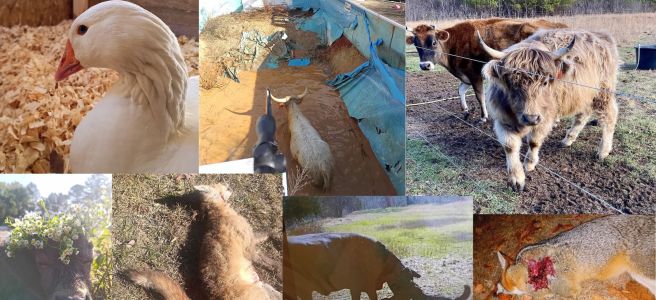

Facebook Hates Farmers

“Don’t let the door hit you on the way out.”

I have always held this policy when leaving a website or social media platform. Announcing your departure generally seems self-serving and attention-seeking to me.

I have never understood the need to make your personal exit into a big drama, except for maybe a brief note for people who want to stay in contact.

This time, however, is different.

I’ve made my living off of social media and marketing for virtually my entire career. I was an early pioneer in the field of Facebook ads and have been running them since before Facebook pages existed. I can confidently say that I have more experience with and understanding of the platform than the vast majority of Facebook employees.

I didn’t make the decision to leave Facebook lightly. I am, however, confident that I won’t be back.

Why?

Because Facebook Hates Farmers.

That’s a bit simplified, as Facebook/Meta seems to hate a lot of people these days. However, after moving to the country a couple years ago and starting a farm, I very quickly realized how far down the fascist thought-control rabbit-hole Facebook has fallen.

If you look at my Facebook feed, it shows a rosy and cheerful picture of farm life. Snuggling with cows, playing with chickens, working on construction projects… as far as my Facebook friends are concerned, life on the farm is great.

In fact, I’ve had many people express shock when I see them in person and talk about farm life. “You don’t post about any of that on Facebook” is the most common response I get.

I don’t post about it on Facebook because I can’t post about it on Facebook.

I’m not here to whine or gripe about everything we’ve been through over the past two years. I consider us to be extremely blessed. Having this farm has given both of us purpose that we didn’t have before, and the animals are like living with an amazing team of much-appreciated employees and friends.

It’s not that things are bad here. It’s that normal, everyday farm life is actively banned on Facebook and all of it’s subsidiaries. And I feel like it is important to talk about it because most people do not know it is happening, since Facebook controls so much of what we see and believe these days.

Those cutesy reels of fluffy cows and chickens aren’t real. I mean, they happened, but they are so heavily staged and censored that it is understandable that you would think that everyday farm/homesteading life actually resembles that.

I’m not talking about farm chores, either.

There are two vital, completely indispensable parts of farm life that are not just banned but actively and aggressively suppressed by Facebook/Meta.

The first of these may seem to make sense on the surface, but it causes far more harm than good. It has to do with a commonly-used phrase among farmers:

1. “Where there is livestock, there is deadstock.”

We believe in and practice a very different type of farming than most farmers. Specifically, my wife and I are advocates of what is called “permaculture” farming, which essentially means to work alongside nature as a partner instead of constantly trying to fight it and force it to change.

One result of this is that our farm actually sees far less death than a normal farm/homestead, thanks to a healthy living environment and an extremely biodiverse local ecosystem. Additionally, we raise our animals with the mindset that our job is to help them survive and thrive, rather than to keep them cooped up. Healthy meat is essential to the diet of any omnivore, humans included. But, just because we eat animals doesn’t mean we have to be jerks about it. Proverbs 12:10 says “A righteous person knows the needs of his beast, but the compassion of the wicked is cruelty.” God commands us repeatedly in the bible to treat livestock and other animals with compassion and care. So, that’s what we do.

Over the past two years, our farm has had virtually no deaths due to disease, malnutrition, or neglect. There are only two small exceptions that I can think of at the moment. We had one baby chick get trampled in a brooder because we accidentally put way too many birds in it thanks to our incubator doing a better job than we expected. We also had three or four adult chickens die from a respiratory disease that was brought onto the farm by some new breeding stock I acquired a couple months ago.

Other than that, every death on this farm has been due to predators or the animal’s stupidity.

And that’s where things start to get weird.

Our local area used to be covered with farms. Thanks to age, drugs, and children not sticking around, most of those farms have completely disappeared over the past decade. I can only think of one real “farm” within a half-mile radius of our house, and that’s a hobby farm with a couple dozen cows or so, similar to ours in size but more well-established.

This phenomenon has resulted in a major predator problem, thanks to the world’s most aggressive apex predator (humans) being largely inactive here except for a very small number of deer hunters during the fall. To make it worse, we are surrounded by overgrown federally-owned land that is not even slightly monitored or maintained by the department that owns it.

The final nail in the coffin is the fact that our animal control department is criminally negligible. They may be underfunded, but I can personally attest to the fact that these incompetent nincompoops know almost nothing about animals and will flat out refuse to deal with any situation that seems even slightly scary, even when lives are on the line. Their repeated refusal to contain feral dogs that literally had to be pried off of the near-dead body of one of my bulls almost killed me earlier this year.

This has caused a massive feral dog problem in my county. In fact, two people were mauled to death by dogs in one recent 12-month period, with a third person ending up comatose for months. Still no change in the activities or attitudes of the local animal control department.

This feral dog infestation cost our farm an estimated $30,000 – $50,000 between mid 2022 and mid 2023, mostly consisting of infrastructure repairs and emergency upgrades, vet bills, dead livestock, time off work, and my own medical bills – because they almost killed me twice, both times in broad daylight.

This problem got so bad that I had to quit trying to farm full-time. I sold cows until I could fit what I had left in my small front pasture where I could keep a close eye on them and build better fences for them. Then, I went back to work. Permanently .

One of the most infuriating aspects of this struggle was the fact that I couldn’t talk about it on Facebook – to anyone.

The first time we had feral dogs attack, I thought a coyote had gotten some of our chickens. I posted in a closed, private group on Facebook specifically for homesteaders asking for advice on how to deal with coyotes – and my post was almost immediately flagged by Facebook. I tried re-wording it several times and appealing it, but Facebook made it very clear that I could not specifically mention wanting to kill any animal, ever, in any context. All while my feed was full of hunters posing with trophies.

As an early adopter of Facebook and someone who has used it as my primary form of communication for well over a decade, I was flabbergasted by the fact that I was banned from asking anyone for advice on how to save the lives of my animals by dispatching an aggressive, invasive, and non-native predator (coyotes are not native to North Alabama). I was told I could discuss trap-and-release, which is extremely damaging to local ecosystems and results in far more animal deaths than otherwise, but I could not discuss any type of responsible and permanent solution to the problem.

I then simply tried posting an update on what had happened, without coming close to mentioning wanting to kill the predators, only to learn that I could not even post about my own farm animals dying, regardless of how they died. I certainly couldn’t post any photos or videos, even though what I tried to post was showing an animal that had survived, although they (one of my two prized Highland bulls) had been severely injured and permanently disfigured.

I see plenty of people make posts about dead animals in various groups, but I understand the Facebook algorithm enough to know that it is easy to get away with it until you get caught once and a red flag is put on your account. After that, your posts are under a(n AI) microscope and your whole account can be taken down in less than a minute if you dare step across their arbitrary and poorly defined line.

As someone whose income at the time relied on doing marketing work and Facebook ad consulting for clients, I couldn’t take risks with my account. So, I stopped talking about life on the farm – except for the occasional cute photo of a fluffy cow or one of my favorite chickens.

This is how censors work. This is how propaganda works. I unfortunately spent the first 8 years of my professional career deep in politics and PR work, so please understand that I am being very literal here, and not exaggerating. Let me say that again: this is how propaganda works. You suppress thoughts that disagree with your agenda by suppressing the speech of those speaking out against it, ensuring that the opposing side’s point of view is never heard in the first place. Once enough people believe your side of the story, the mob rules and they will shut down any dissent.

Facebook’s policies on animals and farming are largely dictated by PETA, and have been for several years. They managed at some point to get several people on the board that dictates these things, and the situation has been getting worse and worse. PETA is a horrible and nasty organization that is responsible for countless animal deaths and environmental damage due to their uncompromising stance on protecting invasive non-native species that effectively wipe out local ecosystems.

Dogs, for example, aren’t typically a problem when domesticated. But once a few feral dogs have babies and those babies have babies, you very rapidly see predators, pets, livestock, and prey alike get wiped out across a fairly large area. Pigs are even more destructive to local environments. Both of these species must be aggressively hunted down and killed by humans once they reach a multi-generational feral status. These are not native species. They are dangerous and destructive and we are responsible for introducing them into the environment, which makes us responsible for permanently removing them from that environment.

Feral hogs and feral dogs are the only two species in my part of the world that will actually hunt, kill, and eat humans – for food or even just for sport. But, heaven forbid PETA finds out we dared to shoot one! You can’t rehabilitate feral animals. Maybe one or two, with enough time, early enough into an infestation, but not an out-of-control and rapidly-multiplying population of them.

So, thanks to Facebook, I was left to fend for myself. I spent weeks trying to find a way to find help and advice via Facebook – valuable weeks that cost me many thousands of dollars, put me in the hospital, subjected me personally to two separate feral dog attacks in broad daylight, and resulted in the deaths of four cows, the near-death of an extremely expensive bull (that still has no ears or vocal chords), and countless smaller animals.

To add insult to injury, I couldn’t even buy my way out of my predicament. Why? Because…

2. Selling livestock is strictly banned on Facebook.

Once my account was flagged as a “coyote killer” or whatever label they use for profiles of farmers trying to survive, I couldn’t get away with anything. All farmers know that they aren’t “allowed” to sell animals on Facebook, but we all do it – in private groups, mostly, using keywords designed to avoid the Facebook censors. I couldn’t even do that anymore.

Imagine being under siege by highly intelligent feral dogs for 12 months straight. That’s what I went through. We suffered massive losses and the only way we survived was by spending a lot of money – on new fences, ammunition, medical bills, etc.

Naturally, I had to sell animals. Especially my cows – who were being killed at a pace of one a week for a while.

Now, imagine being under siege by highly intelligent feral dogs… and not being allowed to do anything about it.

It took weeks and months to make even the smallest amount of progress – in many ways thanks to Facebook. I had animals die while I was trying to rehome them because my posts and profile kept getting flagged and deleted. I kept having to rewrite and re-post my sale posts for weeks before they’d get approved. We almost went bankrupt because I had built a career around using Facebook as my main means of communication and commerce, and it had suddenly been taken away from me, while pretending it was still there for me to use.

Selling livestock is how farming works. You can’t be a farmer and not buy or sell livestock.

I don’t even sell animals for meat at the moment – I sell them as pets! I raise highly intelligent Scottish Highland cows and train them to be kid-safe for small family farms. They are a wonderful way for kids to learn about animals and they inspire so much curiosity and excitement about farming and country living. They are also very productive and hardworking companion animals for homesteads that will live and happily work with you for up to 20 years.

That almost sounds like a cause PETA would be proud of, right? An almost-hippie nature-loving organic chemical-free farm where animals aren’t killed but instead raised to be as healthy, happy, and free as possible? No… instead, shame on me for trying to “profit” off of it!

Also… Facebook is toxic.

I shouldn’t really need to explain this one, and I won’t spend much time on it. Try scrolling your news feed or reading a comment section for more than one minute without having sensational headlines and messages shoved in your face that are designed solely to trigger negative emotions – panic, anxiety, stress, anger, etc. That’s, quite frankly, not a world I want to live in anymore. So, I’m leaving.

Where to?

This is the part where I’m supposed to pitch some fringe social media network with zero chance of ever succeeding… right?

Nah.

The problem is much wider than Facebook. Social media in general is currently toxic, because humanity is toxic. We have all forgotten why we are here on this earth and we have all collectively seemed to have decided that things like human decency and respect aren’t relevant anymore.

So, where to?

Nowhere.

Well, actually, here.

Welcome to my world.

This is an old blog that I occasionally posted articles on, mostly work related. But now, it’s how I will keep up with the world, and it is how you can continue to stay updated on our farm life. If you love my posts about fluffy cows and chickens but are also interested in hearing what life is REALLY like outside the range of the censors, hit that subscribe button or shoot me an e-mail at middleforkfarmsal@gmail.com and I’ll make sure you get updates when I post new articles.

Basically, if you are like me and strongly believe that the human race currently sucks so you’d rather hang out with chickens, fluffy cows, or literally any other animals besides other humans… welcome to Middle Fork Farms.

P.S.: I’ll be updating this website soon… ish. If it frustrates you that some of the information is out of date, you are welcome to come do my farm chores while I fix it.